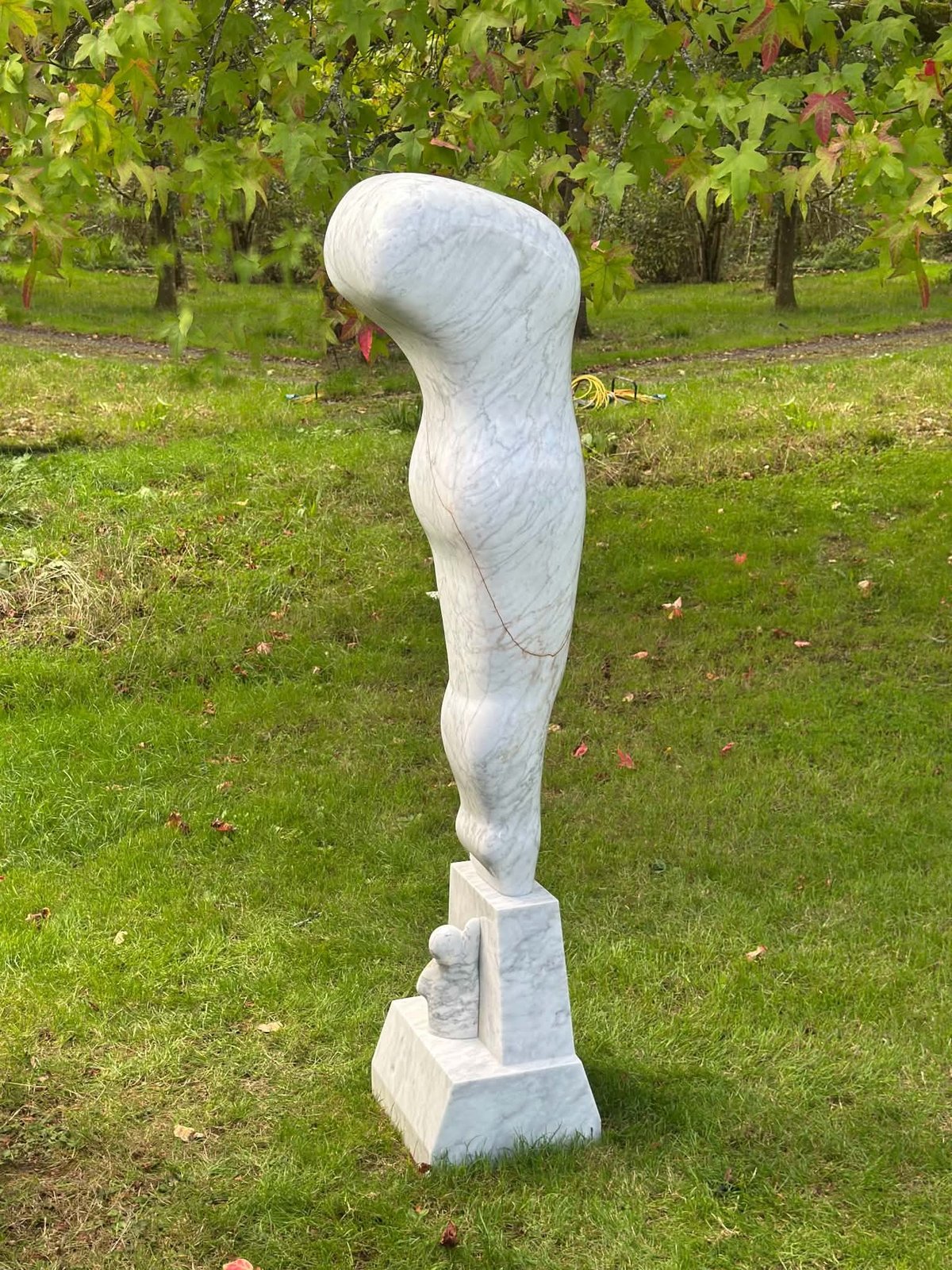
The short answer to whether marble statues can be outside is yes: marble has stood in gardens and public squares for centuries. It does change outdoors, however. Rain, frost, pollution and plant growth all act on the surface, so where and how a piece is sited matters as much as the stone itself.
What happens to marble outdoors
Marble is a metamorphic rock, formed when limestone recrystallises under heat and pressure, and it is made largely of carbonate minerals such as calcite. Carbonates react with acids. Rainwater is naturally slightly acidic, and pollution can make it more so, so over many years an outdoor marble surface slowly dissolves at a microscopic level.
The first sign is usually a loss of polish: a surface that was glossy in the workshop becomes softer and more matt. Over longer periods exposed areas can roughen and fine detail can soften. Sheltered areas, by contrast, may gather dirt and dark deposits that rain does not wash away.
Can marble statues be outside all year
They can, and frost is the main concern in a British winter. Water that finds its way into cracks, veins or open joints expands as it freezes, and repeated freezing and thawing can gradually widen them. Pieces that stand in damp ground or hold water in hollows are more at risk than those that drain freely. A few simple choices make a real difference.
- Stand the piece on a firm, level base, such as a stone plinth or a paved footing, rather than bare soil.
- Make sure water drains away from the base and does not collect in hollows.
- Avoid placing it directly beneath trees, where sap, leaf litter and bird droppings can stain the surface.
- Keep it clear of sprinklers, fertiliser and garden chemicals, some of which can mark stone.
- In hard winters, consider a breathable cover or a move under shelter, and avoid wrapping stone in plastic, which traps moisture.
- Check that the piece is stable on its base and cannot easily be knocked over.
How long do marble statues last
Marble is durable enough that sculptures carved more than two thousand years ago survive today, although many of the best preserved were kept indoors or lay buried for long periods, which protected them from weathering. Outdoors, a marble statue changes more quickly, but sited sensibly and looked after it can last for generations.
What changes is mainly the surface rather than the form: polish dulls, colour can mellow, and sharp edges slowly soften. Some owners value that change as part of a piece living in a garden. Others prefer to keep a polished work under cover, in a conservatory, a covered terrace or indoors.
Polished surfaces and mixed materials
A highly polished marble surface shows weathering sooner than a matt or honed one, simply because any loss of gloss is easier to see. That is not a reason to keep polished marble indoors, but it is worth knowing before choosing a spot in full exposure.
Sculptures that combine marble with other materials need a little more thought, since each material weathers in its own way. The maker is the best person to advise on how a particular piece will behave outside.
Asking about a specific piece
Zak Stevens's Are You Looking Up has been photographed in a garden, on a lawn before a stone cottage and beneath autumn trees. It is white marble finished in gold kintsugi, a tall female form with a small companion figure, on a carved marble plinth, and it is in Bruton, Somerset.
Whether any piece suits a particular garden depends on its finish, its base and the conditions where it will stand. The general guidance here applies to marble broadly; for advice on siting one of Zak's works outside, write to hello@zakstevens.art before deciding.
Questions
Can marble statues be left outside in winter?
They can, but frost is the main risk. Make sure the piece drains freely and is not sitting in wet ground. In very hard winters, a breathable cover or a move under shelter gives extra protection.
How long do marble statues last outside?
Sited well and cared for, they can last for generations. The surface weathers gradually, losing polish first, while the form itself endures far longer.
Does rain damage marble?
Slowly. Rain is mildly acidic and gradually dissolves the surface of marble, which is why outdoor marble loses its polish over time. Good drainage and occasional gentle cleaning help.
Should I seal a marble garden statue?
Opinions differ, and some sealers can trap moisture or change the look of the stone. Ask the maker before applying anything. For Zak Stevens's work, write to hello@zakstevens.art.