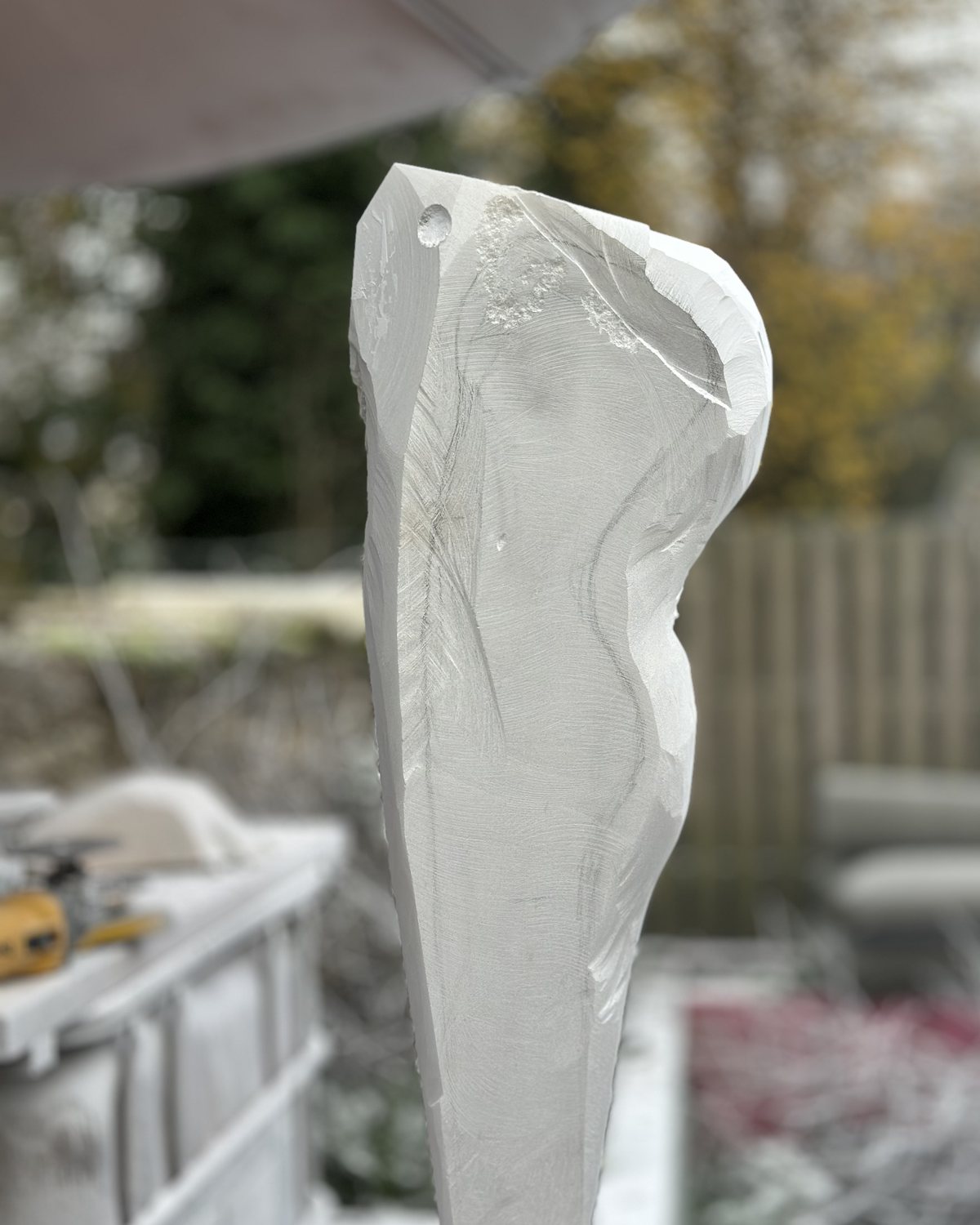
Marble sculptures are made by carving: the sculptor starts with a solid block and removes stone until the form is reached, then refines the surface with progressively finer tools and abrasives. Because nothing can be added back, every cut is final. Methods range from traditional chisels to modern power tools, but the principle has not changed.
Choosing the block
Every carving begins with the stone. Sculptors look for a block that is sound and large enough to contain the intended form, and they study its colour, veining and any flaws, because these carry through into the finished work. A crack in the wrong place can end a piece, while a well-placed vein can strengthen it.
Blocks are cut from the quarry face with large saws and moved with cranes and hoists, since even a modest block of marble is very heavy. Lifting gear stays essential in the workshop, where the stone has to be raised, turned and set down safely many times.
Many sculptors work from drawings or a small model, often called a maquette. Historically, measurements were transferred from a full-size model to the block using a pointing machine, which records positions in three dimensions. Others carve more directly, drawing on the stone and letting the form develop as they work.
Roughing out the form
The first stage removes the bulk of the unwanted stone. Traditionally this was done with a heavy point chisel and a hammer or mallet, followed by toothed chisels, often called claw chisels, which shape the surface more evenly. Today many sculptors use drills, angle grinders and diamond blades for this work, alongside hand tools.
The form is checked constantly from every side, since a sculpture in the round has no single front. Carving produces fine dust and considerable noise, so eye, ear and breathing protection are standard.
How are marble sculptures made today
Zak Stevens carves the human figure by hand from a single block. He works in an open-sided timber workshop beneath a clear roof, with a chain hoist for lifting and grinders on the wall, and his process follows a clear order.
- The block is drilled.
- The figure is drawn on the stone in pencil.
- The form is cut in and shaped with the grinder.
- The surface is worked through abrasives of increasing fineness until it is smooth to the touch.
Refining and finishing
Once the form is established, flat chisels, rasps and rifflers, which are small curved files, can refine the surfaces. The finish is then brought up with abrasives, working from coarse to fine, often with water to keep the dust down. A sculptor may stop at a matt, honed surface or continue to a high polish, and some leave tool marks deliberately as a contrast.
In Zak's work nothing is cast or moulded, and no cut can be taken back. Where the stone opens along its natural veins, he finishes it in gold kintsugi and leaves the line visible as part of the piece.
Why carving takes time
Carving is slow because stone is unforgiving. Removing too much in one place cannot be corrected, so each stage proceeds in small steps, with the figure turned, studied and marked up again. Heavy blocks need lifting gear to move safely, and finishing alone can occupy a long stretch of the work. The result is a single original rather than a cast.
Zak's own process photographs show these stages, from the roughed-out figure on its block in the workshop to Are You Looking Up finished in the garden.
Questions
What tools are used to carve marble?
Traditionally, point, claw and flat chisels with a hammer or mallet, then rasps, rifflers and abrasives. Many sculptors now also use drills, angle grinders and diamond blades.
How long does it take to carve a marble sculpture?
It depends on the size, the complexity of the form and the finish. Even a modest figure involves many stages, and a large or highly polished piece takes considerably longer. For a particular work, ask Zak at hello@zakstevens.art.
Are marble statues carved from one piece?
Many are carved from a single block, though some historical works were assembled from separately carved parts. Zak Stevens carves the human figure by hand from a single block.
How do you polish a marble sculpture?
By working the surface through abrasives of increasing fineness, usually with water, until it is smooth. Continuing to the finest grades brings up a gloss.