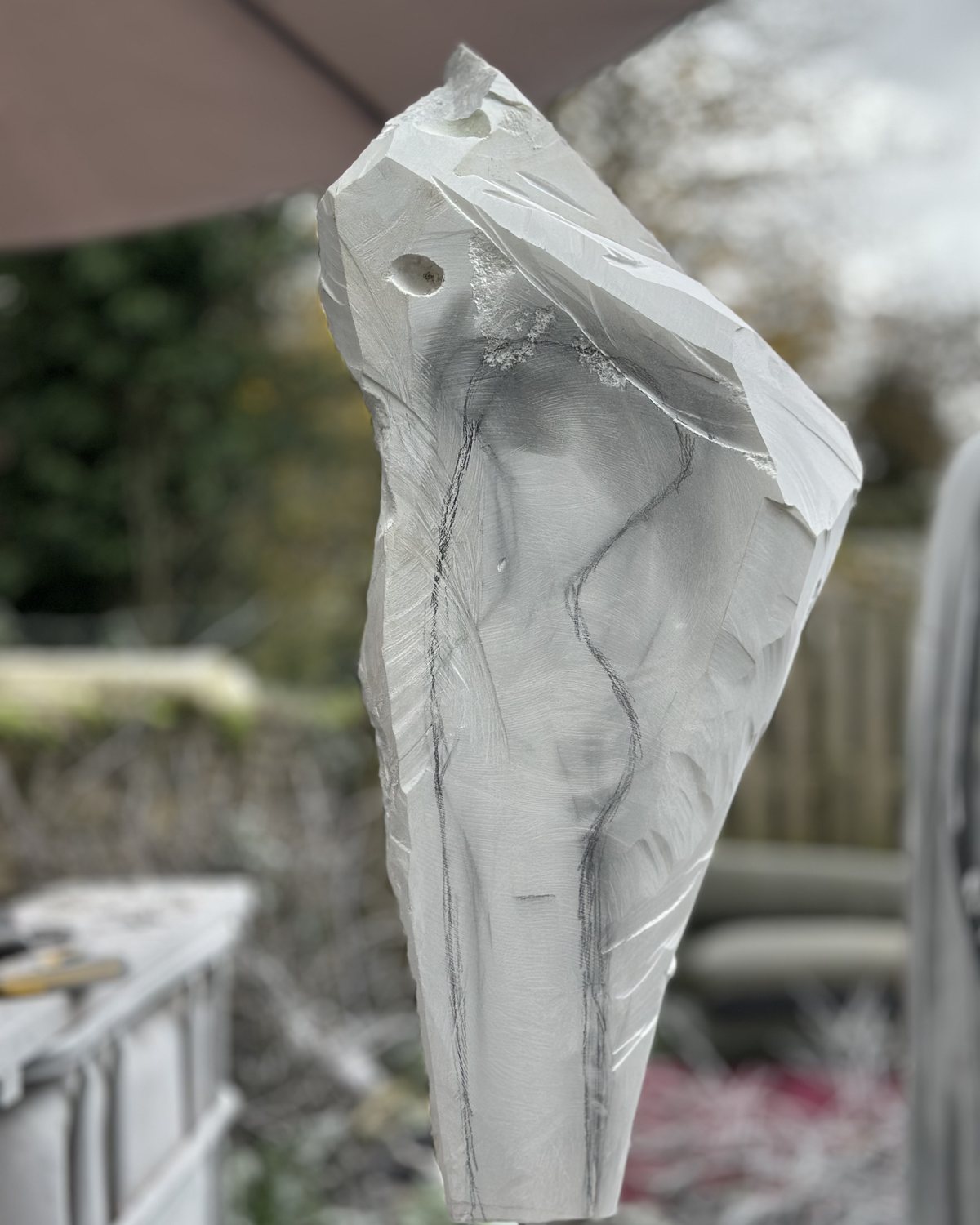
A hand carved marble sculpture is cut from a solid block of natural stone by a sculptor, rather than cast in a mould or milled by a computer-controlled machine. The differences show in the weight, the temperature and veining of the stone, and the surface itself. This guide sets out what to look for and what to ask before you buy.
Three ways a marble-look piece is made
All three of the following are commonly sold as marble sculpture, so it helps to know which you are looking at.
- Hand carved: a sculptor works a block of natural marble with hand-held tools, from chisels and grinders to abrasives. Each piece is an original.
- Machine carved: a computer-controlled milling machine or robot cuts the form from stone, following a digital model. The stone is real, and pieces are often finished by hand, but the same form can be produced repeatedly.
- Cast: a liquid mix, often resin with crushed marble or stone powder, is poured into a mould. The result can look like marble, but it is not carved from a block, and many identical copies can be made.
Signs of a cast piece
Casts are the easiest to identify, because they differ from stone in their material as well as their method. These are the usual signs.
- Weight: resin-based casts are usually noticeably lighter than solid stone of the same size.
- Temperature: natural stone feels cool to the touch, while resin feels closer to room temperature.
- Seam lines: faint lines where the sections of a mould met, often along the sides or beneath the base.
- Bubbles: tiny round air holes on the surface or underside.
- Veining: in natural marble the veins run continuously through the form and around its edges, while in a cast they may be absent, painted, swirled or repeated.
Signs of machine carving
Machine-carved stone is real marble, so weight and temperature will not distinguish it. The clues lie in the surface and in repetition. Areas left unfinished, especially recesses that are hard to reach, may show fine, regular ridges from the cutting tool. Very even, highly symmetrical detail, or identical versions offered in several sizes, also suggest a digital model.
Hand carving tends to leave small variations: a form that responds to its particular block, surfaces refined by eye and touch, and veining that sits where the stone itself placed it.
What to ask the maker
A sculptor or seller should be able to answer plainly on each of the following points.
- Whether the piece was carved by hand, and from a single block.
- Whether it is unique, or one of a series or an edition.
- Whether there are photographs of the work in progress.
- What the stone is, and how it should be cared for.
- Its dimensions and weight, and whether a plinth is included.
Hand carved marble sculpture by Zak Stevens
Zak Stevens carves the human figure by hand from a single block. Nothing is cast or moulded, and no cut can be taken back. The block is drilled, the figure drawn in pencil, the form cut with the grinder, and the surface worked through abrasives of increasing fineness until it is smooth to the touch.
No two blocks are alike, and the colour and veining of each stone carry through into the finished work. Are You Looking Up, in white marble with gold kintsugi, is in Bruton, Somerset. For viewings, dimensions or questions about how it was carved, write to hello@zakstevens.art.
Questions
How can you tell if a marble statue is real?
Natural marble is heavy, feels cool to the touch, and has veining that runs continuously through the form. Light weight, mould seams, air bubbles or repeated patterns suggest a cast.
What is cast marble?
Cast marble is usually a mix of resin and crushed marble or stone powder, poured into a mould. It can look like stone, but it is not carved from a block.
Is CNC carved marble real marble?
Yes, the stone is real. The difference lies in how the form was cut: by a machine following a digital model, rather than by a sculptor working the block by hand.
Why does hand carved marble cost more?
It takes far longer, each piece is an original, and the sculptor carries the risk of a hidden flaw in the block. There are no savings from repeat production.